Nine Hard Truths About Job Hunting in the Netherlands (and Beyond)
I recently published a post about how summer is actually a great time to look for work, contrary to what most people assume. I laid out dates, timelines, the Dutch holiday calendar, and more. Then the responses started coming in, friends who told me politely, and perhaps with good reason: “You are wrong. My experience was completely different.”
So there is a conflict here. On one side, my message. On the other, your experiences. So what is the truth, really? Maybe I really am wrong?
The answer I want to offer: there is no truth. Certainly no eternal truth, and certainly not in a process as human and complex as finding work in a new country.
And for the record, I really do not think I know more than most people. There are people in this community who are sharp and experienced on levels I am not. But after eight years running the community of Israeli tech workers in the Netherlands, and meeting so many of you in person, I will put it this way: I do not know more than most people. I probably know more about most people. I simply see you.
And what happens when you see enough processes? An intuition gets built. Malcolm Gladwell, the Canadian journalist, wrote a whole book about this, Blink, and his claim is simple: an expert’s intuition is not a guess, not magic, not karma. It is compressed experience, which sometimes we cannot even explain to ourselves. Gladwell opens the book with an ancient Greek statue that a museum bought after fourteen months of meticulous scientific testing, and with art experts who, despite all the tests, felt within a second that it was a fake. They could not explain why. They had simply seen enough statues. Gladwell calls it thin-slicing. I call it perspective.
In that spirit, here are nine points I see repeating again and again. These are not eternal truths, each has its exceptions, and you probably know one. And still they come up often enough to be worth saying out loud. If you are a little frustrated with the search, the key might be in one of them.
1. Enough spraying in every direction
I spoke recently with someone looking for full-time work. Eight hours a day, five months, six applications a day. We did his honest math together: one interview for every three hundred applications. One in three hundred. And even that single interview opened with the words “I have to understand why you even applied to me.” I told him: play the lottery, your odds are better. This is not a personal failure. The process is simply broken, and you are really not alone in it.
And here is what truly hurts: every hour of endless LinkedIn refreshing comes at the expense of an hour on something else, and time is the most precious resource we have. Worse: the moment you are rejected, you are marked in the recruitment system as rejected, and in the Netherlands, precisely because of the heavy emphasis on equal opportunity, the recruiter’s hands are tied from then on, even if someone senior wants to help. You burned a bridge before you even crossed it.
So what does work? Do not look for jobs, hunt companies. An open role is a bonus, not a starting point. Five companies you target seriously beat five hundred you sent to and were forgotten. The question is not whether to apply, but how much of your day this Sisyphean task deserves. And the answer: very little, if at all.
2. Generalists out, expertise in
The market is no longer looking for “another software engineer,” it is looking for an expert who solves a specific problem in a specific context. And this is also why a job posting is usually an arbitrary definition someone in HR (or their agent) drafted in five minutes, and the odds it fits you like a glove are low.
I know what some of you are thinking: “But I have moved between so many roles and fields, my track record looks like a salad.” Good, that is exactly where the gold is. With a discerning eye and a bit of creativity you can almost always find the thread that ties it all into one coherent story, and the expertise that is yours alone. You do not need to be the one who roughly fits many. You need to be the one who fits few exactly. That is the name of the game.
3. Nothing beats a personal connection
Around 70% of the good jobs in the Netherlands are filled through acquaintance, not through a job board. And here is something surprising: research shows that it is actually the distant connections, the acquaintances, the ones you have not spoken with in a year or ten, that bring in more jobs than close friends. Your wide network is worth gold, you just need to wake it up.
My whole method is a single arrow in a fixed order: company, department, person, conversation, opportunity. And by the way, you build these connections before you need them, systematically and gently. An important note: looking for “someone at Booking to refer me in” is not a personal connection. Usually it is a waste of energy and a waste of time.
4. You are salespeople
No matter which role you are going for, engineers, analysts, or HR people, at the end of the day you are salespeople. And you have exactly one product to sell: yourself. So act accordingly. Invest in the product, develop it, differentiate it, build it a clear and coherent name that walks into the room ahead of you.
But pay attention: this product has to be real, complex, and three-dimensional. You cannot fake authenticity, and employers smell both a fake and a lack of passion from a mile away. The local market is small and runs on trust, and it has an excellent memory, so a small lie today costs dearly tomorrow. And how do you build a name? Not with a list of roles, but with impact: what you changed, what you solved, what value you brought. Give real value to the community around you too, and you will find the name builds itself. And yes, it is tiresome, I know, but invest in LinkedIn. There is no choice.
5. Want to start working somewhere? Start working there
This is perhaps the most important point here, and also the least intuitive. Instead of asking to be accepted, simply start behaving as if you are already there. It starts with deep research on the company you chose. In the age of AI this is more accessible than ever: read their blogs, listen to the managers’ podcasts, understand where they stand, what hurts them, where they are heading.
And then, instead of “I am looking for a job,” you come with “I saw that you are dealing with X, I have a thought.” Send an idea to the relevant person. Talk like someone already on the team, someone already solving a problem for them. The difference between a job seeker and a colleague who brings value is all the difference in the world, and it starts in your head.
6. Do not look for a job, look for the job
In uncertain times the temptation is to take anything that pays, and to say (and pray) “just let them accept me.” Careful, that is a trap. And not only because you will be miserable.
Here is the less intuitive part: your highest chance of being accepted is actually in the place that fits you exactly, not the place where you compromise. Because when the fit is real, the employer feels they cannot afford to miss you. In the place where you compromised, you are “just” another reasonable candidate. And beyond the odds, your enthusiasm throughout the process, your fulfilment in the work, and how long you last in the role are all at risk from day one. So no, finding a job is not the goal. Finding the right job is the goal.
7. Be hard to get (at least a little)
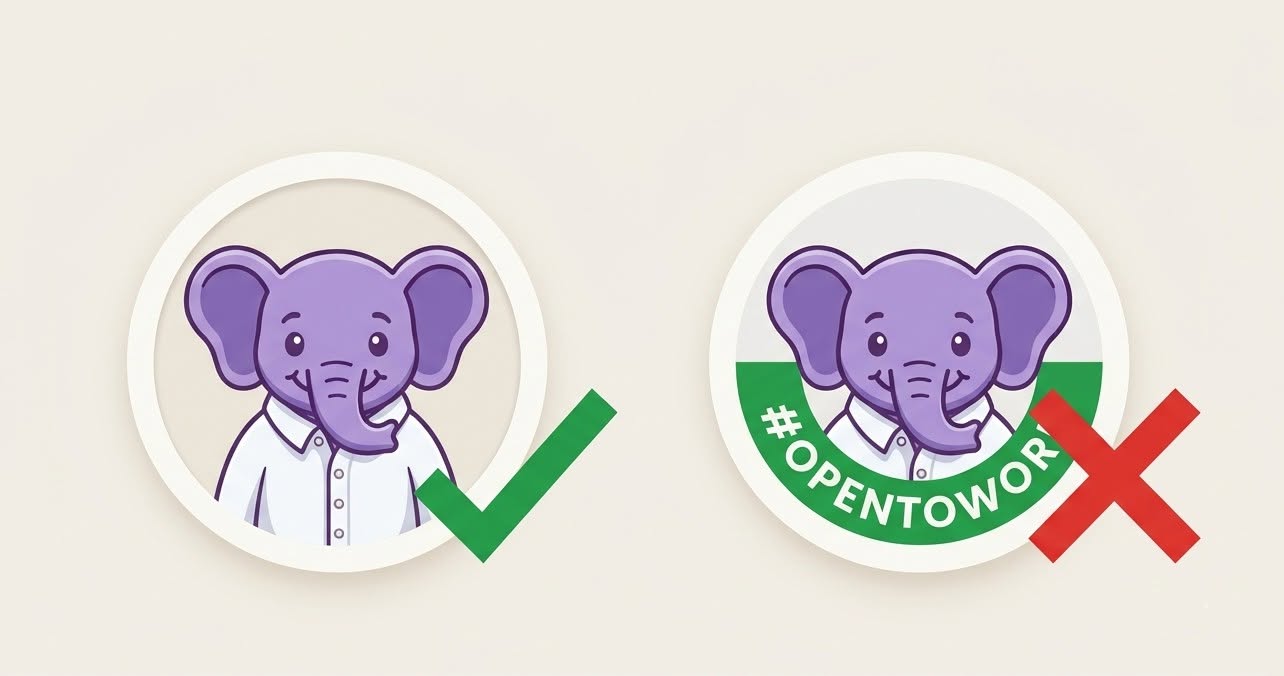
Do not put up #OpenToWork. The green badge on your profile photo signals one thing only: I am in need. And the moment you signal “I am in need,” you have lowered your own value. Telling your close network that you are on the move is important and critical, that is where doors open. But there is a chasm between whispering into the right ear and hanging a neon sign of distress in front of the whole world.
Be nice, real, honest, and modest, but a little reserved. Create a reality, and a mindset, in which the employer needs you more than you need them. Let the recruiter feel they landed a rare opportunity, not that they are doing you a favor. Being in demand attracts more demand, and it shifts the whole balance of power in the room.
8. Remote is easier
Finding a job in the Netherlands remotely, before you have landed here, is easier in most cases than finding one after you have already arrived. It sounds counterintuitive, I understand, because intuition says “let us get there, settle in, and then search from the ground at ease.”
But in practice, while you are still there, you are an interesting story: someone with a unique background who is considering a move to them specifically. Arriving without a job, on the other hand, puts you under pressure, on a ticking clock, and in the status of “another local job seeker” in the pile. It is much easier to attract when you are still rare. So if you are planning a move, start searching long before the flight, not after.
9. Job hunting is work (hard work)
After everything we have said, here is the least sexy news: all of this is work. Hard, exhausting, and it demands discipline. With a written plan, with defined hours in the calendar, with a method and with follow-up. The difference between the person who closes in two or three months and the one who gets stuck for nine months and more is usually not luck and not experience, but the absence of a method. And if you invest at least as much time in thinking and research as you invest in firing off CVs in every direction, good things will happen. A good job search does not start with a CV. It starts with a plan.